Washington Square Voices: Gates Survey Report
Washington Square Park Entrances and Gates – Community Feedback
July 13, 2026
What this report is
This report was prepared by the Washington Square Association (WSA) as part of our Washington Square Voices initiative and shares what we heard from 331 neighbors and visitors about the idea of installing gates at the entrances to Washington Square Park. The survey does not advocate for or against gates and is not a vote or referendum; it is a baseline snapshot of community sentiment, meant to surface themes, highlight where views diverge, and share those perspectives transparently with community members and public officials.
Download the full report
About Washington Square Voices
Washington Square Voices is WSA’s new initiative: an independent community input channel for local government, including Community Board 2, the Department of Parks and Recreation, the NYPD, and elected officials. Voices is designed to supplement, not replace, the formal public process by creating additional avenues for community members to weigh in on major decisions affecting Washington Square Park and the surrounding neighborhood.
About the Gates Survey
The Washington Square Park Gates Survey was conducted to document current perspectives on the idea of installing gates at park entrances and to share those perspectives with Community Board 2, city agencies, and neighbors. It used a non-scientific, self-selected sample and should be read as a directional snapshot of where the community conversation is, not a referendum result.
How the survey was shared
The survey was distributed to Washington Square Association members, featured on the WSA website and social media, and shared with area groups including the Neighborhood Action Group, Washington Square Park Conservancy, Judson Memorial Church, and the Greenwich House Older Adult Center on the Square. Flyers were posted around the park perimeter and neighbor-to-neighbor outreach extended the reach further; to include senior center voices, a hard-copy survey was completed on paper and entered by hand.
Survey limitations
This baseline survey is most useful for surfacing themes and pointing to questions that need a serious hearing, not for counting votes. It reflects a self-selected sample; some groups are underrepresented, especially younger people and NYU students, and responses are geographically concentrated in nearby ZIP codes. Qualitative comments are anonymous and unverified. A fuller discussion appears in the PDF report.
Topline numbers
Total respondents: 331 neighbors and visitors.
Grouped overall positions: 176 oppose gates (53%), 116 support (35%), 39 neutral or unsure (12%).
260 of 331 respondents (79%) live within walking distance of the park.
70% visit the park daily or several times a week.
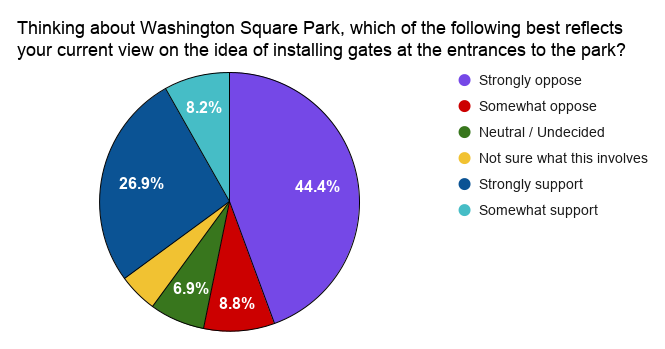
Survey responses on the idea of installing gates at Washington Square Park entrances (baseline snapshot of sentiment, not a referendum).
Who responded
The survey skews toward walking-distance neighbors and frequent park users, so results should be read as a snapshot of this engaged group’s views. The report notes that connection to the neighborhood matters: walking-distance neighbors are nearly evenly divided, while respondents from elsewhere in Manhattan, the outer boroughs, and outside New York City oppose gates overwhelmingly.
Connection to the area around Washington Square Park. Most respondents live within walking distance, reflecting a primarily neighbor-driven sample.
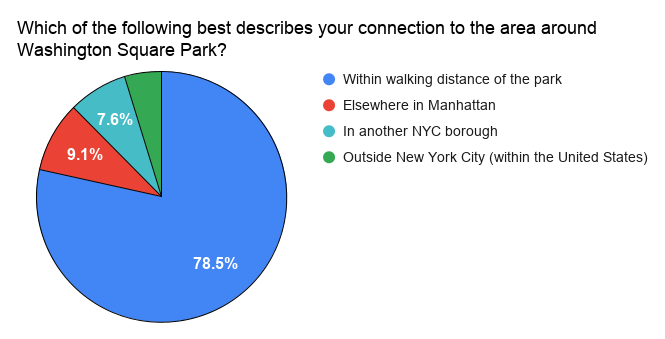
Connection to the area around Washington Square Park. Most respondents live within walking distance, reflecting a primarily neighbor-driven sample.
What is clear
What we heard from 331 respondents is that the question in front of us is not reducible to aesthetics or a simple for-or-against on gates. Beneath that surface question sit deeper ones about who the park is for, how it is governed, how safety and openness are balanced, and what kind of civic space Washington Square Park is meant to be. Supporters and opponents agree on many of the problems and credit recent improvements; they disagree on what to do next.
Key themes
Supporters of gates tend to see permanent infrastructure as a way to enforce curfew and sustain recent gains in safety and quality of life. Common themes include dissatisfaction with the current French barricades, concern about late-night disorder and next-morning conditions, a desire to sustain recent public safety improvements, and interest in better management of quality-of-life issues in and around the park.
Opponents of gates generally agree that there are problems to address but see gates as the wrong tool, with risks to the park’s identity and public character. Major themes include concern about privatization and exclusion, protecting the Arch and open-air character of the park, skepticism that gates would actually keep people out, and the view that enforcement and staffing, not hardware, have driven recent improvements.
Neutral and undecided respondents are generally asking for more specifics before taking a position. They ask about design details, operating plans, hours of closure, impacts on demonstrations and civic events, and the evidence base for any change.
Shared concerns across the survey
Across supporters, opponents, and undecided respondents, several themes emerge repeatedly.
Protecting the Arch / Fifth Avenue entrance and preserving the Arch in full view.
Sustaining recent improvements in safety and quality of life.
Doubt that gates alone will keep motivated people out.
Insufficient signage and interest in clearer rules at every entrance and within the park.
Interest in chains and signage as a possible alternative to permanent gates.
Ongoing concerns about amplified music, illegal vending, skateboards, and e-bikes as daytime quality-of-life issues separate from the gates question.
Unresolved questions about any daytime use of gates and how permanent infrastructure might be used during major civic events or demonstrations.
Status update and next steps
On May 21, 2026, Community Board 2 passed a resolution asking the Department of Parks and Recreation to study and present alternatives to the temporary French barricades currently used to close Washington Square Park overnight. The resolution did not endorse a single outcome; it requested a range of options, from chains and signage to more substantial gates, evaluated for safety, inclusivity, efficacy, budget, and aesthetics in a historic district.
Community Board 2 has transmitted the resolution to senior Parks leadership. Parks staff have indicated they will review the request; it’s unclear on whether they can, or will want to, devote the needed resources. Parks is also working on updated park signage, and the Association will continue to advocate that issues bearing directly on the gates question, such as signage, safety, and park rules, be considered together in a coherent, transparent committee process.
If and when specific proposals to close entrances to Washington Square Park are presented, the Washington Square Association intends to survey the community again.
Looking ahead
Alongside the gates conversation, the Association is beginning to consider what else deserves attention in and around the park. Over the coming months, WSA will share a short “What we’re working on” update and in the fall a broader listening exercise to help the community shape where the Association puts its energy next.
Contact
For more information, please contact:
Erika Sumner
President, Washington Square Association
washsquareassn@gmail.com
(646) 397-3740