What 331 Neighbors and Visitors Told Us About Gates in Washington Square Park
A Washington Square Voices report
This first edition was shared with Community Board 2 (CB2) leadership on May 27, 2026, containing 297 responses. The survey closed on June 27, 2026, and this second edition contains all 331 responses as well as a real, current example from this summer’s Pride weekend that addressed one of respondents’ three key points of divergence.
Why Washington Square Voices
Washington Square Voices was created in response to what neighbors told the Washington Square Association (WSA) directly: they wanted a say in a fast-moving Community Board 2 discussion about installing permanent gates at the entrances to Washington Square Park. The gates survey was built to bring far more neighbors into that conversation than a single evening meeting could hold, and to establish a lasting channel for neighbors, and everyone who cares about this park, to take part in major decisions about it.
The WSA believes our whole community is better when civic engagement thrives
As an independent organization with no decision-making authority over the park, the WSA is uniquely positioned to do this work. Washington Square Voices surveys and reports are a neutral effort to amplify our neighbors’ voices, not alter them: offering their insight to local government and informing the Association’s own advocacy.
What Happened the Last Time the Community Considered Gates (2005)
Historically, changing access to Washington Square Park has required early and robust community input. When major redesign discussions began in the early 2000s, the Washington Square Association (WSA) worked alongside community members and city officials to navigate plans and raise millions for the project. WSA board members who also served as Community Board 2 (CB2) representatives during that era recall how emotionally charged the gate discussions were; access to the park was a deeply felt community issue, rather than a minor administrative detail (a sentiment that survey data shows remains just as powerful today).
Gates press coverage (2005)
Press coverage documents a nearly identical debate two decades ago.
The New York Times, May 10, 2005: “Washington Square Park, Haven for Eccentricity, Is Set to Fall Into Line” previewed the original redesign proposal, quoting a MacDougal Block North Association representative who worried the plan was “stripping away much of its character and freedom.”
The New York Times, May 18, 2005: “Parks Dept. Cancels Plan for Gates at Washington Square” reported that the Parks Department dropped the gates plan following strong objections from Greenwich Village residents.
amNewYork, May 24, 2005: “Landmarks approves park plan but nixes locked gates” covered the Landmarks Preservation Commission’s 7 to 1 approval of the broader redesign, with the one modification being the removal of the proposed permanent gates.
The Gates Debate Resurfaces (2026)
CB2's Parks and Waterfront Committee took up the issue on May 6, 2026. The agenda described the item as "Discussion about the installation of gates at Washington Square Park entrances to replace the police barricades," language that treated gates as the outcome under discussion rather than one option among several. Ten community members spoke at the meeting.
Our CB2 testimony
Gates press coverage (2026)
The gates question drew sustained press attention across the Community Board 2 process. A selection of that coverage:
Daily News, May 6, 2026: “Push to install gates at NYC’s Washington Square Park to enforce midnight curfew sparks controversy” covered CB2’s Parks & Waterfront Committee taking up the gates question for the first time and quoted WSA President Erika Sumner.
NY1, May 6, 2026: “Washington Square Park gate debate reignited” reported on the committee discussion, quoting the WSA; the video segment includes an interview with WSA President Erika Sumner.
Daily News, May 26, 2026: “Controversial plan to install gates at NYC’s Washington Square Park takes a key step forward” covered CB2’s May 21 vote to send the resolution requesting Parks Department alternatives to the barricades, and quoted the WSA.
West Side Spirit, May 27, 2026: “Proposal That Could Add Gates for Washington Square Park Advances” reported on the CB2 vote and quoted WSA President Erika Sumner sharing preliminary results (247 responses) from this survey.
WSA Launches a New Channel for Community Input
As a steward of Washington Square Park for over a century, we can speak to the fact that alterations to park access have historically made robust community input, early and often, a vital part of the process. This collaborative approach is exactly what has preserved the park’s character as an iconic civic space. We created the gates survey to include more neighbors than a single evening meeting ever could, establishing a lasting way for everyone who cares about the park to help shape its major decisions.
How the survey was shared
Washington Square Voices opened on May 18, 2026 and closed on June 27, 2026 with 331 responses. It was open to anyone and shared with the Washington Square Association’s membership, through the Association’s newsletter, featured on the WSA website and social media, and shared with area groups including the Neighborhood Action Group (NAG), a grassroots coalition of Greenwich Village residents and business owners; Judson Church; the Washington Square Park Conservancy (WSPC); and the Greenwich House Older Adult Center on the Square. To secure senior center voices, a hard-copy version of the survey was created, and the WSA entered each response into the database by hand. Flyers were also posted around the perimeter of the park, and neighbor-to-neighbor outreach extended the reach further. The next round will expand into tenant organizations and elected official listservs, and will place a special focus on closing the younger-voices gap.
The report is a baseline snapshot of community sentiment, not a scientific poll, and it is not a vote or a referendum. It does not advocate for or against gates. The full report explains in detail what this survey can and cannot tell you.
Report timeline and data scope
- CB2 Parks Committee Meeting (May 6, 2026): First community discussion on gates.
- Washington Square Voices Launches; Gates Survey Opens (May 18, 2026)
- Initial Testimony (May 21, 2026): High-level findings shared at the CB2 full Board meeting, based on 247 responses.
- First Edition (May 27, 2026): Shared with CB2’s Parks, Landmarks, and Board Chairs, based on 297 responses.
- Survey Closes (June 27, 2026): Closed with 331 total responses (34 additional entries).
- Final Edition (September 7, 2026): Based on all 331 responses.
The final 34 responses didn’t change the distribution of views: both the 297- and 331-response samples split 53% opposed, 35% in support, 12% neutral, and the substance of written comments stayed the same. Totals, percentages, and a few quotes were updated accordingly, and an addendum on recent daytime closures was added.
Editorial Approach
This edition underwent a strict neutrality review to keep the language descriptive rather than persuasive, consistent with the survey’s role as a baseline read rather than a vote or referendum. A closer look at the larger sample also found several interpretations the data size couldn’t reliably support. Rather than leave them in place, this edition withdraws or adjusts each one explicitly. None stem from the new responses; they’re revisions to how the report reads its own data, not new data.
Key Analytical Revisions
- Adjusted: how the two written-response fields are weighted, giving primary weight to a respondent’s stated main reason.
- Added: a fuller look at “somewhat” support and oppose responses.
- Withdrawn: the visit-frequency breakdown; differences between groups were too small to support it. Raw visit frequency is still reported.
- Withdrawn: the ZIP code breakdown; too many respondents left it blank to compare reliably.
- Withdrawn: the neighborhood-connection breakdown; it relied on a group too small to support the comparison.
- Withdrawn: age as the single biggest predictor of opinion. Age is still reported, just no longer ranked against other factors.
- Withdrawn: aesthetics as the single most common supporter argument; safety and disorder concerns come up roughly twice as often.
- Corrected: the park’s perimeter fence height, from “3 feet” to the accurate 3.8 feet.
- Withdrawn: Madison Square Park as broadly representative of supporters; it’s a real comparison, just not a majority one.
- Revised: homelessness, mental illness, and drug activity are now discussed as related but distinct concerns.
- Added: a closer look at the misconception that older adults are most likely to favor gates. Support actually peaks among 50 to 64 year olds.
- Added: clarifications on the difference between city law and park-specific rules.
- Added: a new analysis of opinion intensity: 71% chose one of the two strongest options.
- Adjusted: a stronger emphasis on daytime use of gates as a question the community wants answered.
The Voices in This Report
Most are neighbors who use the park regularly
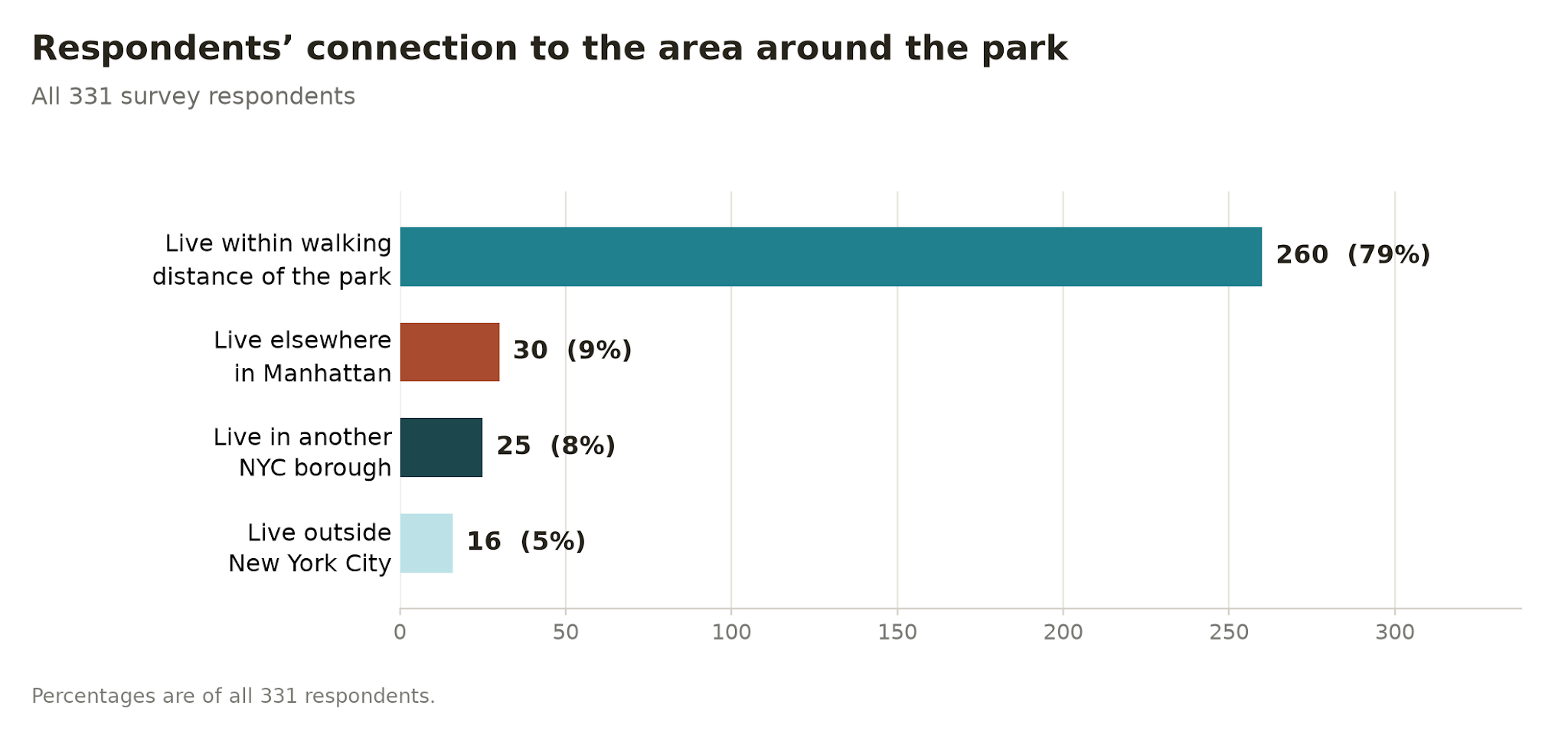
79% of respondents live within walking distance of the park.
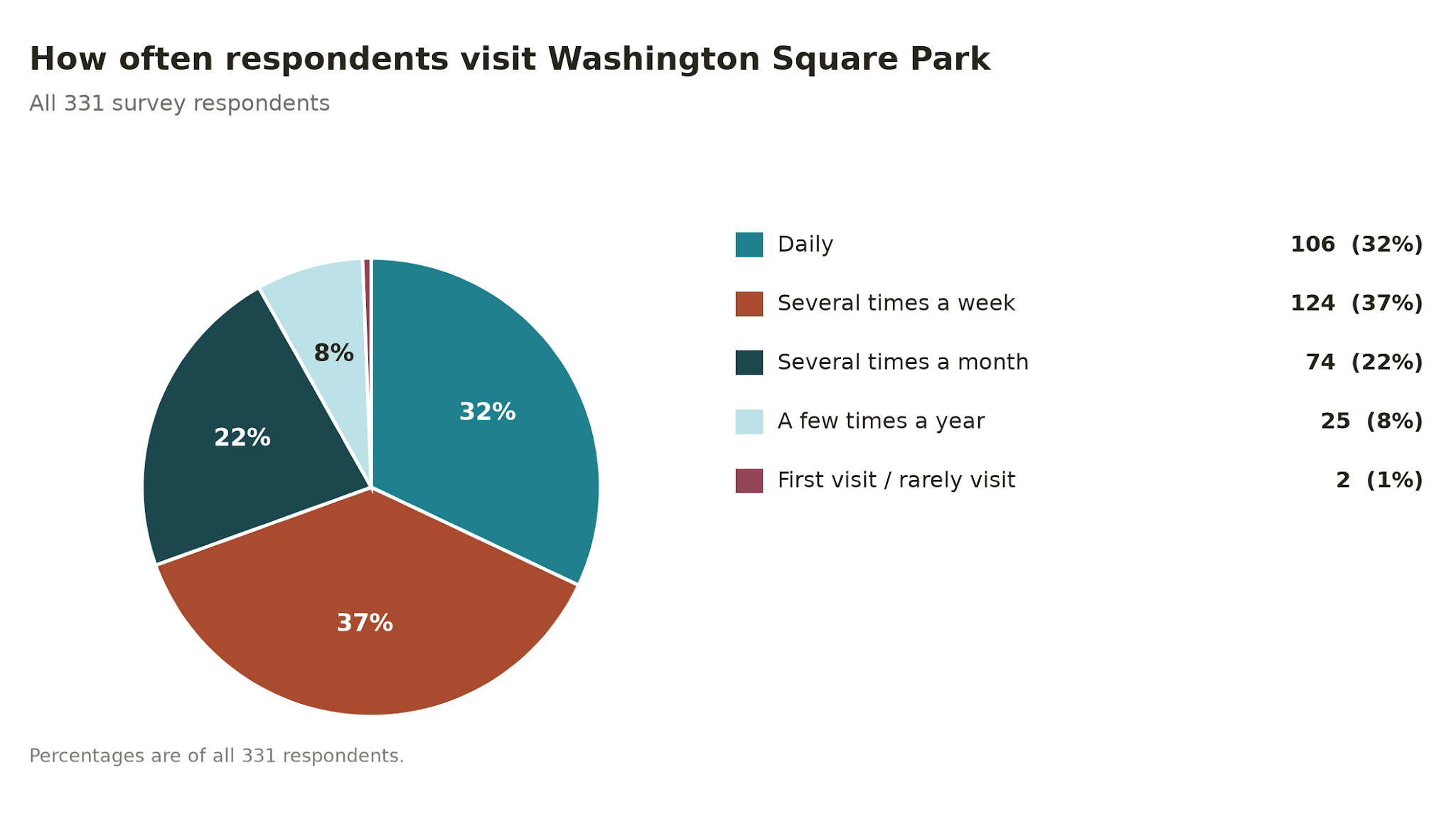
70% visit daily or several times a week.
120 Washington Square Voices
92% of respondents gave permission to be quoted. This survey report amplifies the voices of 120 individual community members through direct quotes.
Essential context: How to interpret these findings
This baseline survey surfaces core themes and highlights where local views diverge. It is a starting point for community dialogue, not a definitive poll or a referendum result. Please keep these limitations in mind when reviewing the data:
- Non-scientific sample: This data reflects the views of 331 self-selected respondents who took the survey between May 18 and June 27, 2026. There was no random sampling or statistical weighting.
- Self-selection bias: People with intense opinions are more likely to participate. This explains the high volume of polar opposites, with 27% “strongly supporting” and 44% “strongly opposing” the gates. Mildly held views are underrepresented.
- Missing youth voices: NYU students and young people are functionally absent. Only 8 respondents (2%) were under 25, largely because NYU was in graduation season during outreach.
- Overrepresented seniors: The 65+ demographic accounts for over 40% of all responses (141 people), reflecting the local outreach channels available rather than the park’s actual user base.
- Geographically concentrated: 79% of respondents live within walking distance, clustered tightly in four adjacent ZIP codes (10011, 10003, 10012, 10014). Outside park visitors and outer-borough commuters are largely missing.
- Unverified written input: All qualitative, open-text responses are anonymous and have not been independently verified.
Core Local Realities
Foundational questions about the park lie beneath the surface question of gates or no gates
- Park Purpose: Who is the park ultimately meant to serve?
- Governance: How are decisions about the park being made?
- Civic Identity: What kind of civic space is Washington Square Park supposed to be?
- Balancing Public Needs: How should public safety and open community access coexist?
Supporters and opponents agree on a lot. Both credit the recent 6th Precinct enforcement push with real improvement, and both want that progress to last. Where they split is on what happens next.
“The recent improvement due to increased police presence is noticeable. Gates would continue that progress.”
Strongly support
“Gates are for Gramercy. The Village is for all. I’ve lived 2 blocks from WSP for 20+ years and strongly believe this.”
Strongly oppose
“I hope that there will be a thorough discussion on a neighborhood level, each step of the way.”
Neutral / Undecided
Gates remain a highly charged issue for this neighborhood
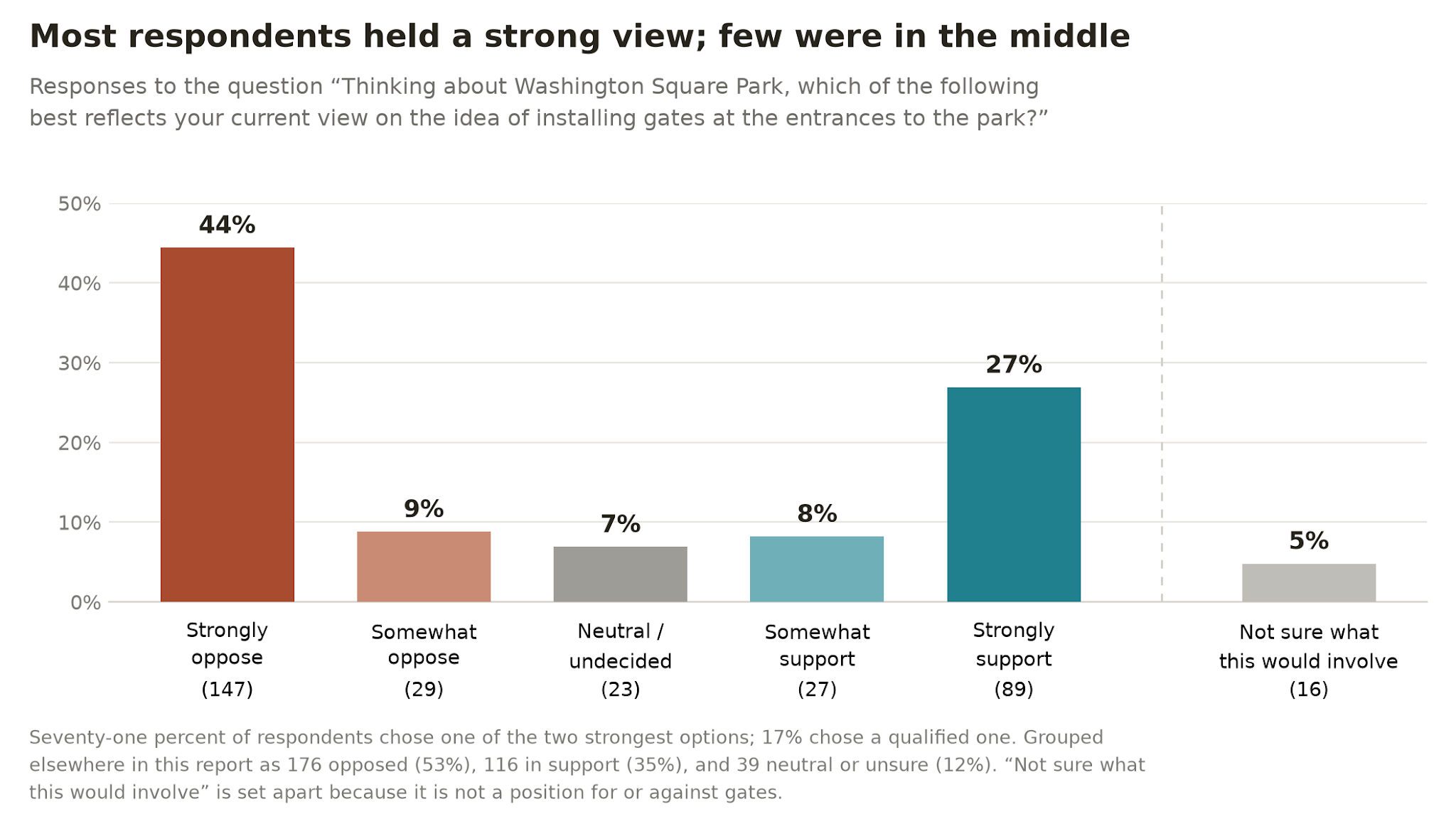
Grouped together, 176 respondents opposed gates (53%), 116 supported them (35%), and 39 were neutral or unsure (12%). But the grouping hides the more telling result: 71% chose one of the two strongest options, and only 17% took a qualified position. This is not a community shrugging at a hardware decision. It is a community with real, deeply held views on both sides.
Neighbors still want a say in what happens in Washington Square Park
Although a major decision was placed on the Community Board 2 agenda before most residents knew about it, the neighborhood responded rapidly once the news broke. Because short notice prevented many from attending the committee meeting, the Washington Square Association launched a survey on May 18, 2026. Despite the survey's limited circulation, it garnered 247 responses in the 72 hours before the vote. This sizable turnout proves that the community's drive for civic engagement and investment in the park remains unwavering.
Overview of Perspectives
Perspectives of supporters (Strongly: 89, Somewhat: 27, Total: 116)
Supporters generally see gates as a practical tool for enforcing an existing nighttime closure, improving conditions at park entrances, and sustaining a safer, better-maintained park. Their comments most often combine broad safety concerns with frustration about enforcement, disorder, and the current use of movable barricades. Those who somewhat support gates raise similar concerns, but focus more on general enforcement of existing hours and aesthetics.
Perspectives of supporters: seven recurring points
- The park no longer feels safe enough. For more than 40% of supporters, the gates question begins with the feeling that the park is no longer as safe to use as it once was, particularly for children, older adults, dog walkers, and nearby residents, more than any single incident.
- Gates would prevent overnight drug activity, trash, and disorder. The second most widely held belief: that gates would be effective at keeping people out after closing, and therefore prevent what follows from that.
- Gates would sustain recent public safety improvements. Supporters credit the 6th Precinct sweep and want to lock in the gains rather than risk losing them.
- The bigger frustration is enforcement of daytime rules and laws. About a third of strongly supportive respondents name problems gates alone would not solve: e-bikes, vending, amplified sound, off-leash dogs, and trash. They connect their support to a broader wish for consistent enforcement throughout the day, not just overnight.
- Curfew already exists; gates are about enforcement, not restriction. A repeated framing: the park is already closed at midnight under existing rules, so this is a question of enforcing a rule that already exists, not creating a new one.
- The current French and police barricades are ugly and noisy. One in five supporters made the aesthetic case on its own: that well-designed gates would simply be an improvement over what’s there now.
- Madison Square Park is the model. When supporters invoke it, the comparison is as much about management and upkeep as it is about gates specifically.
Perspectives of opponents (Strongly: 147, Somewhat: 29, Total: 176)
Opponents do not generally treat gates as a narrow question of whether the park should close at night. They see gates as a decision about the identity of Washington Square Park: whether it remains visibly open, public, spontaneous, and shared. Their comments combine strongly held values with practical concerns about access, effectiveness, design, cost, and governance. Those who somewhat oppose gates concentrate on practical grounds, like enforcement over infrastructure.
Perspectives of opponents: nine recurring points
- Public parks should be open: civic identity, character, and history. This is the emotional center of the opposition responses, mentioned by more than 70% of them. Openness is framed as a right, not a preference.
- Gates effectively change who the park belongs to. Concerns about exclusion are almost as present as openness itself, including a class-framing sub-thread where gates read as elitist or as criminalizing the people most likely to be shut out.
- Fear of privatization. One of the strongest currents in the opposition responses: concern that gates could make the park easier to close off from public use over time.
- The community needs a real voice in the decision. Opponents want to be included before a decision takes shape, and many are asking for a clearer, more transparent picture of how the park is actually governed day to day.
- The park is safer than it’s been in years, and enforcement, not gates, is why. Many opponents believe the park is genuinely safer now than it has been in years, a direct counterpoint to supporters who describe it as unsafe, and credit the improvement to sustained staffing and active policing rather than permanent infrastructure.
- The problems in the park are more complex than gates can solve. Drug use, homelessness, and mental health crises are seen as too complex for entrance control to fix, with a specific worry that gates would just move or hide the problems rather than resolve them.
- Gates will not keep motivated people out. A practical, not philosophical, objection: the low perimeter fence means gates would inconvenience rule-followers without deterring anyone determined to get in.
- Spend the money where it will matter more. Funds spent on permanent infrastructure are funds not spent on staffing, sanitation, and other needs opponents believe would do more for daily park life.
- Barring nightly routes disrupts neighbors’ lives without adding to security. For nearby residents, park barricades impede their path home, can lower perceived safety en route, and create accessibility or mobility barriers, particularly when they go up early.
A related current within point 2: comparisons to Gramercy Park and other “gated community” framing recur across several stances, alongside a distinct class-framing thread.
Perspectives of neutral, undecided, and not sure what this involves (Total: 39)
12% of respondents (39 of 331) answered either “neutral / undecided” (23) or “not sure what this involves” (16). Both groups represent less an absence of opinion than a withheld one.
Perspectives of neutral, undecided, and not sure: two recurring points
- Waiting for basic information, not a persuasive case. Most respondents in this group aren’t undecided between arguments, they’re missing the proposal itself: what gates would look like, cost, hours, and what problems they’re meant to solve.
- A genuine, weighed trade-off. Some respondents understand the proposal fully and remain torn, balancing a real aesthetic or civil-liberties cost against a real, if unproven, safety benefit.
Cross-cutting perspectives (shared by multiple camps)
These showed up across multiple groups, and several are issues the Board should hear regardless of where members land on gates.
Cross-cutting perspectives: eight shared concerns
- Most dislike the aesthetics of the current French barricades. Opponents’ preferred fix is a chain plus signage; supporters’ is permanent gates.
- Recent improvements should be sustained. All camps credit the same enforcement changes for the park’s recent turnaround; they disagree only on how to maintain the gains.
- Daytime enforcement gaps and trash frustrate across the board. Vending, e-bikes, skateboards, amplified sound, off-leash dogs, and trash are named by all camps as the real daytime quality-of-life issue, separate from gates entirely, though supporters and opponents sharply diverge on whether protest activity belongs on that same list.
- Effectiveness skepticism spans every camp. Supporters, opponents, and the undecided alike question whether gates would actually work, given how low the existing perimeter fence already is.
- Chains and signage as an alternative to gates. Raised by opponents and some supporters as a lower-cost way to communicate closure without the expense or permanence of gates.
- The visual line of the arch should be preserved. Opponents, the neutral and undecided, and the “not sure what this would involve” group all object to anything obstructing the view of the Arch or the Fifth Avenue entrance; this concern is largely absent from supporter responses.
- Insufficient signage is a quietly bipartisan concern. It isn’t anyone’s headline issue, but it surfaces across positions, both as a diagnosis of the current problem and as a cheaper alternative to gates.
- Daytime use of gates is the unresolved question. Before any proposal moves forward, both those who see protest as fundamental to the park and those seeking overnight relief would benefit from a clear answer on what gates would and would not be used for during the day (see Points of genuine divergence § 3 and Daytime Closures: What We Learned From the NYPD During Pride).
Points of genuine divergence
Not every open question here is really about gates. These three issues are where the community disagrees on the underlying problem itself, not just the fix, and any future proposal will need to reckon with that gap directly.
Points of genuine divergence
- The safety baseline itself. Supporters describe the park's current condition in the starkest terms; opponents describe that same recent period as the safest it's been in years, crediting the same enforcement changes. Part of this debate isn't about the right tool, it's a disagreement about whether there's still an acute problem to solve.
- Homelessness and mental illness. Not a factual disagreement but a difference in framing: supporters typically treat it as a safety and quality-of-life concern, while opponents see gates as a blunt tool for problems that need more holistic, sustainable solutions.
- Management of protests and daytime use of gates. Not a factual disagreement but a direct conflict in what people want: some supporters want gates to reduce protest activity, while opponents treat any tool that could restrict assembly as a serious risk.
What CB2 voted to do
On May 21, 2026, Community Board 2 passed a resolution asking the Parks Department to study a full range of alternatives to the current French barricades, from chains and signage to more substantial gates, weighing safety, inclusivity, effectiveness, budget, and aesthetics in a historic district, for later presentation to the community. Parks Department staff have indicated they will review the resolution and let CB2 know whether they can devote the resources to develop alternatives, and on what timeline. The Association remains in touch with the CB2 Parks Committee Chair, who has said he will keep us informed as the Parks Department responds, and we will share any new developments with the community as they become available.
What we’re asking of CB2
What we heard from the community following our recent CB2 testimony only reinforces our core message: process, details, and discussion matter deeply to this neighborhood. Substantive local input is a long-standing blueprint for stewardship in Washington Square. Because the tight timeline surrounding this gates proposal made it impossible to conduct a broader, statistically representative survey, these recommendations matter more than ever: future proposals should reach the community early, with enough time to review, discuss, and respond before any resolution is drafted.
This is not a request to substitute community input for the formal public process. It’s a request to use that process the way it was designed to work.
Allow Greater Community Participation
Give neighbors reasonable time to review and respond
- Present proposals without immediate committee action. Proposals regarding Washington Square Park, including any gates proposal, should first be presented at a public meeting of the assigned committee, solely for information and introduction.
- Guarantee a dedicated community review period. Make proposals public immediately following their presentation so the community has adequate time to evaluate the details before any formal discussion.
- Wait for community feedback before proceeding with a vote. The CB2 committee should hear what the community has to say at a subsequent public meeting, and only then, at that meeting or later, should the issue be considered for a vote.
Reduce Bureaucratic Hurdles
Consolidate connected issues, like signage, under one committee
Issues bearing directly on the gates question, like signage, and more broadly safety, security, and park rules in Washington Square Park, should be handled by the same Parks Committee.
Ensure Clarity on Daytime Operations
Neighbors want to know if and how gates would be used during the day
Any gates proposal accepted for review by CB2 should include explicit daytime parameters for how the gates will and will not function during daylight hours.
That question already has a live example worth learning from.
Daytime Closures: What We Learned From the NYPD During Pride
The initial survey report raised a question voiced by both opponents and supporters: what would gates be used for during the day? Opponents worried gates could limit lawful assembly and free speech, while a subset of supporters called for fewer protests and demonstrations. At the same time, a recent operational precedent became central to that conversation.
On April 20, 2026, to manage the 4/20 Marijuana Smoke-in, the NYPD encircled the park with two rows of barricades, restricted access to a single entry point, and searched bags on entry. At subsequent 6th Precinct Community Council meetings, it was reported that similar strategies would be used for upcoming large events, including Pride, FIFA, and Halloween.
Following pushback from LGBTQ community groups and advocates, the NYPD changed its approach for Pride. In the early morning of Pride Sunday, June 28, 2026, barriers went up to protect plantings and discourage fence jumping, but morning and daytime use of the park and adjacent sidewalks remained normal, all entrances stayed open throughout the day, and access was narrowed only at the Arch. The next morning, Parks Department staff and Washington Square Park Conservancy volunteers worked quickly to return the park to normal conditions; by about 12:30 p.m., there was little visible sign that a massive, day-long event had taken place. (For scale: the Conservancy reports its Pride 2025 cleanup alone collected more than 9,000 pounds of trash.)
This account is offered as a record of what happened operationally, not as a position on the gates question, but as an example of a practical compromise that protected the park while keeping it meaningfully open to the public during a major event. That same balance, between protecting the park and keeping it open, is worth exploring as a best practice for major civic events and holidays going forward.
What You Can Expect From Us
Washington Square Voices was designed to continue beyond the gates conversation, as a supplement to the formal public process, not a replacement for it. We intend to survey the community again if proposals for the park entrances are developed, and to seek your input on other issues that matter to the neighborhood.
Know of an issue we should monitor? Please email us at washsquareassn@gmail.com.
Know when there’s another opportunity to weigh in. Subscribe below