331 Neighbors Weighed In on the Gates Debate. Here’s What They Told Us.
331 Neighbors Weighed In on the Gates Debate. Here’s What They Told Us.
Washington Square Voices was created in response to what neighbors told the Washington Square Association (WSA) directly: they wanted a say in a fast-moving Community Board 2 discussion about installing permanent gates at the entrances to Washington Square Park. We launched the Voices survey initiative 12 days later to make it possible for far more neighbors, and everyone who cares about this park, to weigh in on major decisions in Washington Square Park.
The WSA believes our whole community is better when civic engagement thrives
331 neighbors and visitors responded, sharing everything from where they live and how often they visit to what they think gates would actually change. This survey report amplifies the voices of 120 individual community members through direct quotes and includes a real, current example from this summer’s Pride weekend that addressed one of respondents’ three key points of divergence (see §3 Management of protests and daytime use of gates). The report is a baseline snapshot of community sentiment, not a scientific poll, and it is not a vote or a referendum. It does not advocate for or against gates.
This isn’t the first time Washington Square has had this exact conversation. In 2005, the Parks Department floated a similar gates plan as part of the park’s major redesign, and dropped it after strong objections from Greenwich Village residents. Two decades later, the underlying questions are the same: how are decisions about the park being made and what kind of civic space this park is supposed to be.
Gates remain a highly charged issue for this neighborhood
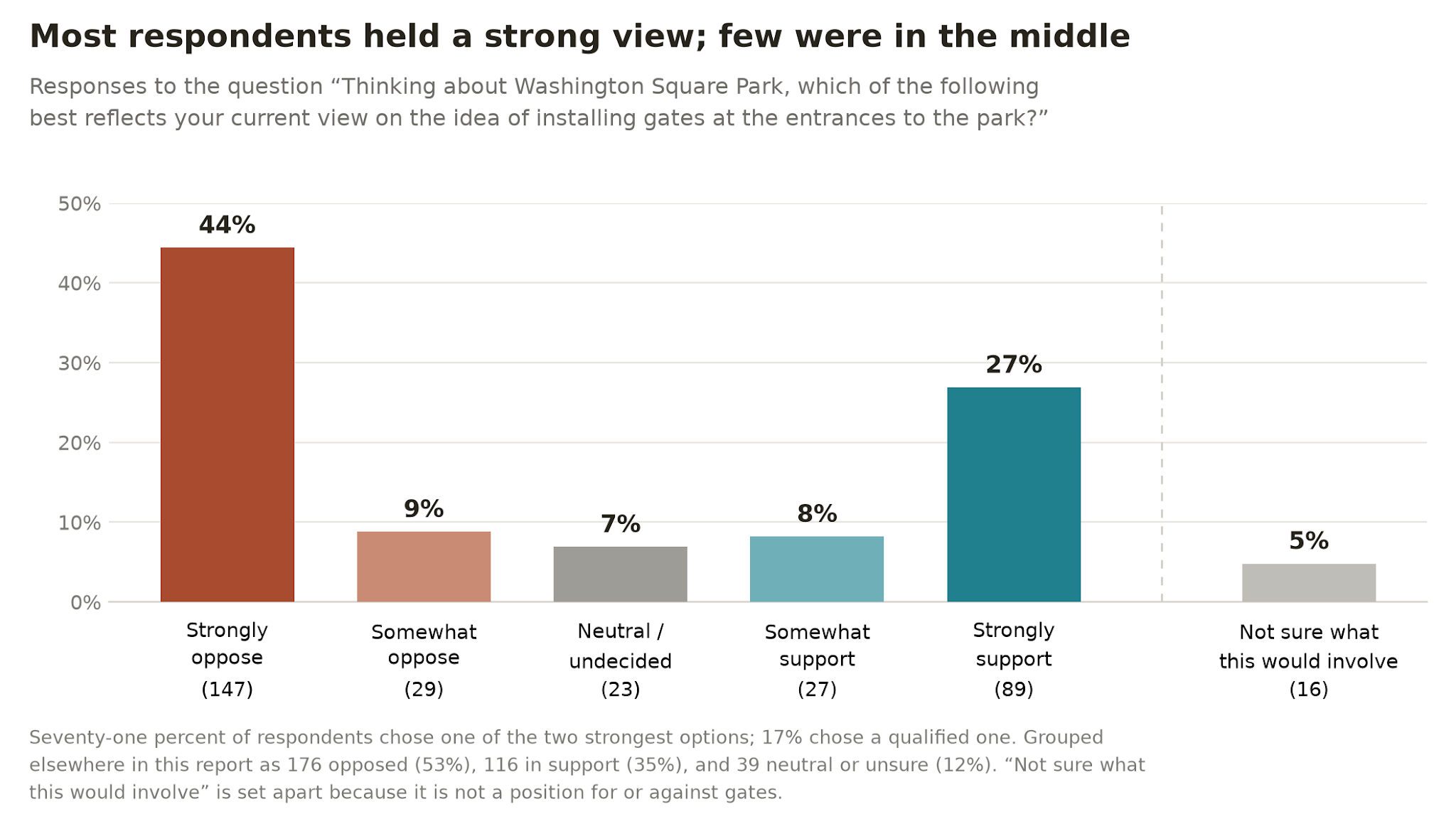
Grouped simply, 176 respondents opposed gates (53%), 116 supported them (35%), and 39 were neutral or unsure (12%). But look closer and a more telling number appears: 71% chose one of the two strongest options on the survey, and only 17% picked something in between. This isn’t a community shrugging at a hardware decision, it’s one with real, deeply held views on both sides.
It’s not all division, though. Supporters and opponents agree on more than you’d expect: both credit the recent 6th Precinct enforcement push with real improvement, and both want that progress to last. Where they split is on what happens next.
Neighbors still want a say in what happens in Washington Square Park
In response, actively engaged community members turned out in remarkable numbers. Even with the brief window to participate, 247 neighbors submitted feedback within 72 hours of the decision, demonstrating that local dedication to civic involvement and Washington Square Park remains deeply rooted.
Perspectives of supporters (Strongly: 89, Somewhat: 27, Total: 116)
- The park no longer feels safe enough.
- Gates would prevent overnight drug activity, trash, and disorder.
- Gates would sustain recent public safety improvements.
- The bigger frustration is enforcement of daytime rules and laws.
- Curfew already exists; gates are about enforcement, not restriction.
- The current French and police barricades are ugly and noisy.
- Madison Square Park is the model.
Perspectives of opponents (Strongly: 147, Somewhat: 29, Total: 176)
- Public parks should be open: civic identity, character, and history.
- Gates effectively change who the park belongs to.
- Fear of privatization.
- The community needs a real voice in the decision.
- The park is safer than it’s been in years, and enforcement, not gates, is why.
- The problems in the park are more complex than gates can solve.
- Gates will not keep motivated people out.
- Spend the money where it will matter more.
- Barring nightly routes disrupts neighbors’ lives without adding to security.
A related current within point 2: comparisons to Gramercy Park and other “gated community” framing recur across several stances, alongside a distinct class-framing thread.
Perspectives of neutral, undecided, and not sure what this involves (Total: 39)
- Waiting for basic information, not a persuasive case.
- A genuine, weighed trade-off.
Cross-cutting perspectives (shared by multiple camps)
- Most dislike the aesthetics of the current French barricades.
- Recent public safety improvements should be sustained.
- Daytime enforcement gaps and trash frustrate across the board.
- Effectiveness skepticism spans every camp.
- Chains and signage as an alternative to gates.
- The Arch is close to a red line.
- Insufficient signage is a quietly bipartisan concern.
- Daytime use of gates is the unresolved question. (See Daytime Closures: What We Learned From the NYPD During Pride).
Points of genuine divergence
- The safety baseline itself.
- Homelessness and mental illness.
- Management of protests and daytime use of gates.
What we’re asking of CB2
Any future proposals should pull the community in early, allowing a reasonable amount of time for us to review, debate, and respond before any final resolutions are drafted.
-
Present proposals without immediate committee action
Proposals regarding Washington Square Park, including any gates proposal, should first be presented at a public meeting of the assigned committee, solely for information and introduction. -
Guarantee a dedicated community review period
Make proposals public immediately following their presentation so the community has adequate time to evaluate the details before any formal discussion. -
Wait for community feedback before proceeding with a vote
The CB2 committee should hear what the community has to say at a subsequent public meeting, and only then, at that meeting or later, should the issue be considered for a vote.
We’re also asking that related issues, like signage, safety, and park rules, be handled by the same committee instead of split across several, and that any future gates proposal spell out exactly how it would and wouldn’t be used during the day.
Daytime Closures: What We Learned From the NYPD During Pride
Initial survey feedback revealed concerns that daytime park gates could restrict free speech or curb protests. That daytime question already has a live example. Ahead of Pride this June, the NYPD had signaled it might use the same perimeter control it used for the 4/20 Smoke-in (two rows of barricades around the entire perimeter and a single entry point with bag checks). Pushback from LGBTQ advocates led to a more open approach for Pride on June 28, 2026. French barriers were placed around the park to discourage fence-jumping and protect plantings and all entrances stayed open. The next morning Parks staff and Conservancy quickly cleaned the area and by 12:30pm, there was little sign a major event had taken place.
This account is offered as an editorial record of what occurred operationally, not as a position on the gates question, but as an example of a practical compromise that helped protect the park while keeping it meaningfully open to the public during a major event. That same balancing of park protection, sanitation, safety, and meaningful public openness is worth exploring as a best practice for major civic events and other significant local holidays.
For more information, including the full report with a breakdown of who responded, where supporters and opponents agree or disagree, and importantly, where they find common ground, click here.
Know of an issue we should monitor? Email us at washsquareassn@gmail.com, and sign up for updates on the report page so you know the next time there’s a chance to weigh in.